The best bench vises for jewelers provide steady, controlled support for engraving, stone setting, filing, drilling, and small repairs without overwhelming a compact workbench. This roundup compares 10 options ranging from dedicated ball vises to portable mini clamps.
Use the buying guide below to match jaw design, rotation, clamping capacity, materials, and workspace requirements to your jewelry-making tasks.
Best 10 Bench Vises for Jewelers Picks for 2026
Precision Engraving Pick

- Self-centering jaws for small jewelry work
- Adjustable rotation brake and double ball bearings
- Includes 17 attachments for engraving tasks
Best For: Stone setting, engraving, and microscope work
Compact Workshop Option

- 0- to 2.48-inch clamping range
- C-clamp and mini drill press mounting options
- Includes soft jaws and V-grooves
Best For: Small jewelry projects, repairs, and drilling
General Bench Support

- 360-degree rotation with 45-degree tilt
- Cast-steel body and hardened jaws
- Rubber protection for jaws and desktop
Best For: General bench clamping and DIY workshop tasks
Complete Jewelry Setup

- 70-piece kit with ring-making accessories
- Self-centering jaws and adjustable rotation brake
- Low-profile design for microscope work
Best For: Ring fabrication, stone setting, and engraving
Best Compact Pick

- Compact aluminum body for portable precision work
- 0–2.1-inch opening handles varied small shapes
- Includes support columns, blocks, and screws
Best For: Jewelry, watch repair, and detailed craft work
Best Adaptive Grip
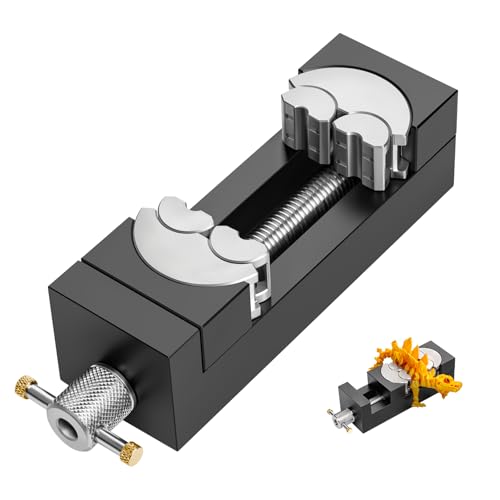
- Traditional and self-adjusting fractal jaws
- Handles regular and irregular shapes up to 62 mm
- CNC-machined aluminum and stainless steel build
Best For: Jewelry work involving uneven, round, or unusual parts
Best Rotating Clamp

- 360-degree rotation aids workpiece positioning
- Lightweight aluminum alloy construction
- Clamps surfaces up to 3.5 cm thick
Best For: Small jewelry, modeling, electronics, and hobby work
Best Portable Precision Pick

- Detachable tabletop or handheld design
- 360° rotation with 90° tilt
- 14 silicone-covered grip rods
Best For: Portable jewelry repair, soldering, and polishing
Best Versatile Clamp-On Pick

- Clamps to tables up to 2.17 inches thick
- 360° tilt and rotation
- Built-in drill or grinder holder
Best For: Flexible jewelry and DIY bench setups
Best Lightweight Craft Pick
Compact Adjustable-Jaw Bench Clamp

- Lightweight aluminum alloy body
- 0–2.1-inch adjustable clamping range
- Includes blocks, columns, screws, and suction cups
Best For: Watch repair, jewelry crafting, and small-part carving
Precision Engraving Pick – DZQ 3-Inch Ball Vise
For jewelers comparing bench vises for jewelers, this compact DZQ ball vise is designed for detailed stone setting, engraving, and microscope work. Its 3-inch stainless steel ball, self-centering jaws, and adjustable rotation brake provide stable positioning without taking up much bench space.
Best For: Stone setting, small engravings, and low-profile microscope work.
Pros:
- Self-centering jaw system helps hold small jewelry work securely.
- Adjustable brake supports anything from free rotation to a locked position.
- Double ball bearings are designed for smooth rotation without looseness.
- Includes 17 attachments in the full set.
Cons:
- The 3-inch ball and 2.13-inch maximum opening limit it to relatively small workpieces.
- Its specialized design is less suitable for general heavy-duty clamping.
This is a focused choice for jewelers who need controlled orientation and compact support rather than a large general-purpose vise. The low profile and included attachments make it especially practical for precision bench or microscope work.
Compact Workshop Option – Mini Drill Press Vise
This mini vise is a versatile option among bench vises for jewelers who also need support for drilling, gluing, sanding, and repairs. The aluminum body, included C-clamp, soft jaws, and 0- to 2.48-inch clamping range suit small projects where flexible mounting matters.
Best For: Jewelry making, modeling, small repairs, and mini drill press work.
Pros:
- Can sit on a tabletop, clamp to an edge, or mount to a mini drill press.
- One-piece clamping block helps keep the movable jaw level.
- V-shaped grooves accommodate cylindrical workpieces.
- Includes rubber soft jaws and POM fixed pillars to help protect surfaces.
Cons:
- The 2.48-inch maximum clamping range is intended for smaller projects.
- Its aluminum construction is better suited to light precision work than heavy clamping.
Choose this model when mounting flexibility is as important as clamping. It is a practical small-project vise for jewelers and makers who want one compact tool that can move between a bench and mini drill press.
General Bench Support – MAXMAN Clamp Bench Vise
For shoppers considering bench vises for jewelers alongside broader workshop tasks, the MAXMAN clamp vise offers a larger, general-purpose setup. Its cast-steel construction, 360-degree head rotation, 45-degree tilt, and rubber protective components provide adaptable support for DIY and light workshop work.
Best For: General bench clamping, larger jewelry-related tasks, woodworking, and DIY work.
Pros:
- 360-degree rotation and up to 45-degree tilting support multiple working angles.
- Steel construction with a chrome-plated spindle and hardened jaws.
- Clamp includes multiple mounting holes and installation accessories.
- Rubber jaw covers and desktop pads help reduce slipping and scratches.
Cons:
- Its 3.2-inch maximum opening may not suit larger workpieces.
- The general-purpose jaw design is less specialized for delicate stone setting than a ball vise.
- The manufacturer cautions against adding leverage because excessive pressure can destabilize the jaws.
This vise makes sense as a flexible bench clamp when your work extends beyond fine jewelry. For highly detailed engraving or microscope-based setting, a dedicated ball vise will provide more specialized positioning.
Complete Jewelry Setup – DZQ 5-Inch Ball Vise Kit
Among bench vises for jewelers, this 5-inch DZQ kit stands out for combining a precision ball vise with 33 ring-making accessories. The self-centering jaws, adjustable rotational resistance, low-profile design, and included ring holders support stone setting, engraving, polishing, and ring fabrication.
Best For: Jewelers who want one expanded kit for stone setting, ring work, and microscope-based projects.
Pros:
- 70-piece kit includes the vise, original precision tools, and ring-making accessories.
- Self-centering jaws and a 3-inch maximum opening hold a range of jewelry pieces.
- Adjustable brake provides free-to-locked rotational control.
- Ring holders, pin bases, and ring blanks support dedicated ring fabrication.
Cons:
- The larger 5-inch vise may require more bench space than a compact model.
- The extensive accessory set may be more than beginners need for a narrow task.
- It is specialized equipment rather than a general-purpose heavy-duty bench vise.
This is the strongest all-in-one option for jewelers building a dedicated jewelry workstation. Its accessory selection is particularly useful for ring-focused work, while the low-profile ball vise remains suitable for controlled microscope tasks.
Best Compact Pick – Mini Bench Vice Clamp
For shoppers comparing bench vises for jewelers, this compact aluminum mini vise is designed for holding small parts during jewelry work, watch repair, crafting, and carving. Its 0–2.1-inch opening range and included clamping accessories make it a practical choice for detailed bench tasks.
Best For: Jewelry, watch repair, sculpture, and other precision projects where a lightweight, space-saving vise is useful.
Pros:
- Compact 4.1-by-2.3-by-1.3-inch design for small workbenches
- Aluminum alloy construction keeps it durable and portable
- Accommodates round, square, and irregularly shaped objects
- Includes support columns, clamping blocks, and fixed screws
Cons:
- Small size is intended for detailed work rather than large projects
- Its 0–2.1-inch opening range may not suit oversized workpieces
This is a straightforward option for jewelers who want a portable vise for light-duty precision work. The included accessories add flexibility, while the compact footprint helps preserve valuable bench space.
Best Adaptive Grip – WhiteRhino Fractal Mini Vise
Among bench vises for jewelers, the WhiteRhino stands out for combining a traditional flat jaw with a self-adjusting fractal jaw. The design is intended to grip regular, round, and irregular parts while spreading contact across multiple points.
Best For: Jewelers and makers who frequently work with uneven, round, or unusual small components alongside standard pieces.
Pros:
- Dual-jaw design supports both regular and irregular workpieces
- Fractal jaw adapts to shapes up to 62 mm; regular jaw grips up to 58 mm
- CNC-machined aerospace-grade aluminum and 304 stainless steel construction
- Non-slip silicone base and stated 300-pound load capacity support stable clamping
Cons:
- Jaw depth should be checked for compatibility with the project
- Requires proper screw tightening and adjustment for best contact
- Its specialized design may be more than needed for simple flat work
The WhiteRhino is a versatile choice when secure positioning across varied shapes matters. Its adaptive jaw system can reduce manual repositioning, but buyers should confirm the jaw depth and setup requirements before purchasing.
Best Rotating Clamp – Mini Jeweler Table Vise
This mini table vise is a useful option for shoppers seeking bench vises for jewelers with adjustable positioning. Its 360-degree rotation, compact form, and clamp-style mounting are suited to small jewelry, electronics, modeling, and hobby tasks.
Best For: Hobbyists and craftsmen who need a small rotating vise for repositioning delicate work on a tabletop.
Pros:
- Rotates 360 degrees and can be positioned at a 90-degree angle
- Lightweight aluminum alloy construction is rust-resistant and portable
- Clamps to surfaces up to 3.5 cm thick
- Fine and coarse adjustment knobs help control jaw pressure
Cons:
- Upper jaw opening is about 25 mm and lower jaw opening about 35 mm
- Small capacity limits it to small parts and compact projects
- Requires tabletop clamping rather than serving as a large fixed bench vise
Choose this model if repositioning the workpiece is a priority and your projects fit its modest jaw capacity. Its rotating, lightweight design is particularly convenient for compact jewelry and hobby benches.
Best Portable Precision Pick – Mini 360° Rotatable Vise
For jewelers seeking bench vises for jewelers that can handle delicate, irregular parts, the TGDGAMER Mini Tabletop Vise offers a compact, adaptable setup. Its detachable design works on a tabletop or in hand, while the rotating and tilting base helps position small workpieces for repair, soldering, polishing, and finishing.
Best For: Jewelry repair, soldering, polishing, and other portable precision tasks involving small or irregular parts.
Pros:
- Detachable 2-in-1 design switches between tabletop and handheld use.
- 360° rotation and 90° tilt support flexible workpiece positioning.
- Fourteen silicone-covered steel rods accommodate tiny, delicate, and irregular shapes.
- Compact steel-and-aluminum construction measures 2.17 x 2.72 x 3.86 inches.
Cons:
- The 0–0.98-inch clamping range is intended for small workpieces.
- Its compact format may not suit larger or heavy-duty bench work.
This is a strong choice when portability and precise positioning matter more than maximum capacity. The interchangeable rods and adjustable base make it particularly useful for detailed jewelry work.
Best Versatile Clamp-On Pick – 3-Inch Rotating Table Vise
Among bench vises for jewelers, this 2-in-1 table vise stands out for its clamp-on installation and integrated drill or grinder holder. It attaches to tables up to 2.17 inches thick without drilling, and its rotating aluminum body can help position jewelry, metal, and other small workshop projects.
Best For: Jewelers and DIY users who want a clamp-on vise with a drill or grinder holder for varied bench tasks.
Pros:
- Clamps to table edges up to 2.17 inches thick without requiring drilled mounting holes.
- Tilts and rotates 360° for adjustable access to the workpiece.
- Includes a 0.97–1.97-inch drill or grinder holder.
- Rubber jaw covers and anti-skid jaw texture help protect and hold workpieces.
Cons:
- The maximum jaw opening is 2 inches, limiting larger workpieces.
- At 2 pounds, it is less lightweight than the smallest mini vises.
This vise is a practical option for a flexible home bench, especially when you want one clamp to support both holding and rotary-tool work. Its 3-inch jaw width and clamp-on base offer useful versatility without permanent installation.
Best Lightweight Craft Pick – Compact Adjustable-Jaw Bench Clamp
For jewelers comparing bench vises for jewelers, this compact flat table vice provides a lightweight way to secure small parts during watch repair, carving, polishing, and craft work. Its adjustable jaws and included support columns, clamping blocks, screws, and suction cups make it adaptable to several small-workpiece setups.
Best For: Watch repair, jewelry crafting, sculpture, carving, and lightweight work with round, square, or irregular objects.
Pros:
- Lightweight aluminum alloy construction weighs 8.4 ounces.
- Adjustable 0–2.1-inch clamping range supports a variety of small parts.
- Includes support columns, multi-purpose clamping blocks, screws, and base suction cups.
- Compact 4.2 x 2.4 x 1.37-inch design is easy to handle.
Cons:
- The lightweight construction is better suited to small DIY work than heavy-duty tasks.
- It is a flat table clamp rather than a larger permanently mounted bench vise.
This model makes sense for jewelers who need a simple, portable holding tool for detailed craft and repair jobs. Its broad accessory set adds flexibility, while the 2.1-inch range covers many small workpieces.
How We Picked the Best Bench Vises for Jewelers
We focused on features that matter at a jewelry bench: precise positioning, secure workholding, compact size, useful jaw movement, and compatibility with delicate materials. The selection includes ball vises for engraving and setting, mini table vises for general repairs, drill-press-style models for controlled clamping, and larger swivel-base designs for users who also work with wood or metal.
We also considered whether each vise is portable or permanently mounted, how easily it can rotate or reposition a workpiece, and whether soft or adjustable jaws help protect rings, watch parts, sheet metal, and other finished surfaces. Product descriptions and listed specifications were weighed alongside the intended use, since a vise designed for heavy woodworking is not automatically the best choice for precision jewelry work.
Quick Comparison
| Best For | Recommended Style | Why It Works |
|---|---|---|
| Engraving and stone setting | Ball vise | Allows broad positioning and controlled access to the workpiece |
| Small repairs and crafts | Mini parallel or flat vise | Compact, simple, and easy to place on a crowded bench |
| Delicate finished pieces | Soft-jaw mini vise | Helps reduce marking and surface damage |
| Drilling and repetitive work | Drill-press-style vise | Provides a stable hold for aligned operations |
| Mixed workshop projects | Swivel-base or multipurpose vise | Offers greater versatility beyond jewelry tasks |
Key Buying Factors for Bench Vises for Jewelers
Jaw Design and Protection
Choose smooth, padded, or replaceable jaws when working on polished jewelry or soft metals. Serrated steel jaws may grip firmly but can leave marks unless the piece is protected with leather, plastic, wood, or purpose-made jaw covers.
Rotation and Positioning
A ball vise or 360-degree swivel design can make engraving, setting, and filing more comfortable by bringing the work into the ideal viewing angle. Check whether rotation can be locked securely; free movement is useful only when the vise remains stable during detailed work.
Clamping Capacity and Footprint
Measure both the maximum jaw opening and the available bench space. Mini vises suit rings, small components, watch repairs, and craft projects, while larger models offer more reach and stability but may be excessive for delicate bench work.
Mounting and Stability
Clamp-on vises are convenient for temporary or shared workspaces. Bolt-down models generally provide better rigidity for repeated filing, drilling, or engraving. Consider the thickness of your bench and whether the mounting hardware is included.
Materials and Adjustability
Cast steel is typically better suited to heavier loads, while aluminum keeps a compact vise lighter and easier to move. Adjustable jaws, parallel movement, and smooth screw action improve control, especially when holding irregular or very small parts.
Who Should Buy Which Bench Vises for Jewelers?
Choose a ball vise if engraving, stone setting, or detailed handwork is your priority and you need to change angles frequently. Choose a mini flat or parallel vise for general jewelry repairs, watch work, modeling, and occasional craft tasks. Choose a soft-jaw model when protecting finished surfaces matters most.
Choose a drill-press-style vise for stable drilling and repeatable positioning. If you also build furniture, repair hardware, or work with larger materials, a swivel-base or multipurpose table vise offers better all-around utility. Before buying, confirm the vise’s opening, mounting method, jaw surfaces, and load expectations match your actual bench work.