Working around frames, brackets, pipes, and narrow metal assemblies calls for more than a standard grinder. The best angle grinders for tight spaces combine compact heads, usable reach, controlled speed, and enough power for the material at hand.
This roundup compares 10 compact, flat-head, pneumatic, and cordless options so you can choose the right balance of access, runtime, control, and safety for your projects.
Best 10 Angle Grinders for Tight Spaces Picks for 2026
Best Low-Profile Cordless Pick
Milwaukee M18 FUEL Flathead Grinder

- Low-profile head reaches confined areas
- RAPIDSTOP brake stops most wheels in under two seconds
- 18V cordless, brushless design
Best For: Cordless grinding in tight metalworking spaces
Best Deep-Cut Corded Pick
Metabo HPT 6-Inch Flat-Head Grinder

- 6-inch disc supports deeper cuts
- Rotatable gear housing improves access
- Tool-free M-Quick disc changes
Best For: Professional fabrication and corded cutting work
Best Extended-Reach Air Tool
Long Handle Pneumatic Angle Grinder

- 12.2-inch handle reaches deep spaces
- Adjustable pneumatic speed control
- 180-degree guard helps block chips
Best For: Air-powered work around pipes, corners, and crevices
Best Flat-Head Reach
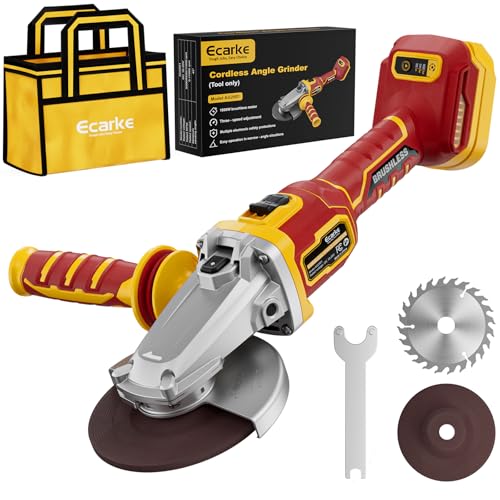
- Extended head reaches behind pipes and into corners
- Compatible with DeWalt 20V batteries
- 11,000 RPM brushless motor with vibration damping
Best For: DeWalt 20V users working in cramped areas
Best Pneumatic Precision

- 90-degree head reaches angled work areas
- 20,000 RPM pneumatic performance
- Includes 1/4-inch and 1/8-inch collets
Best For: Compressed-air users doing detailed automotive or workshop work
Best Compact Kit

- 19,500 RPM motor for light cutting and grinding
- Two 16.8V batteries support battery swapping
- Compact body designed for one-hand use
Best For: Home repairs and light-duty work in cramped areas
Best Lightweight Design

- 19,500 RPM brushed motor for varied light tasks
- Rubberized grip and one-hand design improve control
- Two batteries and six wheels included
Best For: Portable cutting, sanding, and polishing around the home
Best Low-Profile Cordless Pick – Milwaukee M18 FUEL Flathead Grinder
For cordless angle grinders for tight spaces, the Milwaukee M18 FUEL stands out for its low-profile flathead design. It delivers claimed 11A corded power, runs at up to 8,500 RPM, and includes RAPIDSTOP braking for added control after releasing the paddle switch.
Best For: Cordless metalworking where access and quick stopping are priorities.
Pros:
- Flathead design improves access in confined areas.
- RAPIDSTOP brake stops most wheels in less than two seconds.
- Brushless, 18V cordless platform avoids a power cord.
Cons:
- Tool-only package does not include a battery or charger.
- Its 5-inch format may offer less cutting depth than a 6-inch grinder.
This is a strong fit when maneuverability matters more than maximum disc size. Confirm that you already have compatible M18 batteries before choosing this tool-only configuration.
Best Deep-Cut Corded Pick – Metabo HPT 6-Inch Flat-Head Grinder
The Metabo HPT WEF 15-150 Quick is a powerful corded option among angle grinders for tight spaces. Its rotatable gear housing and flathead profile improve access, while the 13.5-amp motor and 6-inch disc support deeper, efficient cuts.
Best For: Welders, fabricators, and finish professionals who need flathead access with corded power.
Pros:
- Flathead design and rotatable gear housing help reach awkward angles.
- 13.5-amp motor and 6-inch disc provide substantial cutting capacity.
- M-Quick system enables tool-free disc changes.
- Electronic safety shutdown, overload, soft-start, and restart protection add control.
Cons:
- Corded operation limits mobility.
- At 6.5 pounds, it is heavier than compact cordless alternatives.
- Its larger 6-inch format may be less convenient in extremely confined spaces.
Choose this model when you need the reach benefits of a flathead grinder but still want the cutting depth and sustained output of a larger corded tool. The quick-change system is especially useful for jobs involving frequent accessory changes.
Best Extended-Reach Air Tool – Long Handle Pneumatic Angle Grinder
This long-handle pneumatic grinder takes a different approach to angle grinders for tight spaces. Its 12.2-inch reach helps access deep crevices, overhead pipes, and corners, while compressed-air operation delivers up to 25,000 RPM according to the product description.
Best For: Ship repair, pipeline work, and metalworking in deep or difficult-to-reach areas.
Pros:
- Extended 12.2-inch handle provides useful reach and working distance.
- Air-powered design avoids an electrical power cord.
- Adjustable speed supports deburring through aggressive cutting.
- 180-degree guard helps block flying chips.
Cons:
- Requires a compressed-air supply delivering 90 PSI and about 4.0 CFM.
- The supplied details list 18,000 RPM in specifications while the description claims up to 25,000 RPM.
- Its 3-inch blade is smaller than the discs used by the other grinders here.
The extended handle is the main reason to consider this tool. It can reach areas conventional grinders cannot, but it makes the most sense for users who already have a suitable air compressor and need pneumatic equipment.
Best Compact DIY Kit – SEESII 3-Inch Cordless Mini Grinder
The SEESII mini grinder is a compact choice for light-duty angle grinders for tight spaces. Its 3-inch disc, 1.83-pound listed weight, and cordless design support one-handed handling, while the kit includes two batteries, a charger, and cutting and grinding accessories.
Best For: DIY users handling light cutting, polishing, rust removal, and small repair tasks.
Pros:
- Compact 3-inch format is easy to maneuver in confined areas.
- Includes two 2.0Ah batteries and a charger.
- Brushless motor reaches up to 19,000 RPM.
- Overheat and overload protection support extended use.
Cons:
- Its 3-inch discs are less suited to large or deep cuts.
- Listed output is 200 watts, making it more appropriate for light work than heavy grinding.
- Accessory assortment may be more useful for DIY tasks than specialized professional work.
This kit emphasizes portability and convenience rather than heavy-duty capacity. It is a practical option for occasional work in cramped areas, especially when having batteries and multiple disc types included is more important than using a full-size grinder.
Best Flat-Head Reach – Ecarke 20V Flat Head Grinder
For shoppers comparing angle grinders for tight spaces, the Ecarke stands out with an extended flat head designed to reach behind pipes, into corners, and along difficult edges. It uses DeWalt 20V batteries, includes a standard 5/8-inch arbor, and combines an 11,000 RPM brushless motor with vibration-reduction features.
Best For: DeWalt 20V users who need cordless reach for grinding and cutting in cramped areas.
Pros:
- Extended flat-head design improves access behind pipes and in tight corners.
- Compatible with DeWalt 20V batteries and common 5/8-inch-arbor accessories.
- Brushless 1,000W motor reaches up to 11,000 RPM.
- Tool-free guard adjustment and dual vibration damping support easier operation.
Cons:
- Tool only; a compatible DeWalt battery is required.
- Overheat protection may place the grinder in standby during prolonged heavy use.
The Ecarke is a strong choice when access is the main concern. Its flat-head profile and cordless DeWalt compatibility make it particularly practical for maintenance, pipe work, and other obstructed grinding locations.
Best Pneumatic Precision – WORKPRO Air Angle Die Grinder
The WORKPRO Air Angle Die Grinder is a compact pneumatic option for angle grinders for tight spaces, with a 90-degree head that helps reach small or angled work areas. Its 20,000 RPM speed, lightweight one-pound body, and included 1/4-inch and 1/8-inch collets suit detailed grinding, deburring, polishing, and cutting tasks.
Best For: Automotive and workshop users with an air compressor who need a lightweight right-angle die grinder.
Pros:
- 90-degree head provides access to tight and angled spots.
- 20,000 RPM continuous operation when supplied by a suitable compressor.
- Includes both 1/4-inch and 1/8-inch collets for varied bits.
- Compact one-pound design supports one-handed use.
Cons:
- Requires an air compressor, which is not included.
- Air supply is limited to the compressor’s capacity and requires 90 PSI operation.
Choose the WORKPRO if you already have compressed air available and want a nimble tool for detail work. The right-angle format and small footprint are useful where a larger electric grinder would be awkward.
Best Compact Cordless – Brushless Mini Makita-Compatible Grinder
When portability matters, this mini grinder is a compact pick among angle grinders for tight spaces. The 1.4-pound tool uses Makita 18V LXT batteries, a 3-inch cutting disc, and a high-speed brushless motor rated at up to 19,500 RPM for cutting, grinding, sanding, and polishing in confined areas.
Best For: Makita 18V LXT users who want a lightweight, one-handed grinder for lighter-duty confined-space work.
Pros:
- Compact 1.4-pound design is easy to handle in restricted areas.
- Compatible with Makita 18V LXT batteries, including BL1850B and BL1860B.
- Brushless motor delivers up to 19,500 RPM.
- Useful for metal, tile, concrete, pipes, conduits, and other solid materials.
Cons:
- Battery and charger are not included.
- Not intended for extended heavy-duty tasks.
- Requires a five-minute cooling period after 15 minutes of continuous operation.
This mini grinder favors maneuverability over sustained heavy-duty capacity. It is a practical match for quick cuts and finishing work where a full-size grinder feels too large, especially for users already invested in Makita 18V batteries.
Best Compact Kit – 3-Inch Cordless Mini Grinder
For shoppers comparing angle grinders for tight spaces, this 3-inch cordless model emphasizes one-hand control and portability. Its 19,500 RPM motor is suited to light cutting, grinding, and material removal on metal, wood, and light tile, while two batteries support extended DIY sessions.
Best For: Home repairs, outdoor maintenance, corner work, and light fabrication where cordless portability matters.
Pros:
- Compact 3-inch design can reach cramped corners and plumbing spaces.
- Two 16.8V 2000mAh batteries allow quick swapping during projects.
- Includes six cutting discs, charger, adjustable guard, and spindle lock.
- Lightweight body supports controlled one-hand operation.
Cons:
- Not recommended for heavy concrete, thick stone, or dense floor tile.
- Its compact format is better suited to light-duty work than demanding fabrication.
This is a practical grab-and-go option for light jobs in confined areas. The included accessories add convenience, but users tackling heavy masonry should choose a more substantial grinder.
Best Safety Features – TEENO 3-Inch Cordless Grinder
The TEENO mini grinder is a strong candidate among angle grinders for tight spaces, combining a slim 3-inch form with a 19,500 RPM motor. Its stated cutting depth of up to 1/2 inch makes it useful for trimming pipes, cutting rusty bolts, and handling small household metalwork.
Best For: DIYers and homeowners needing a compact secondary tool for pipe trimming, bolt cutting, and household repairs.
Pros:
- Slim 3-inch design is intended for cramped corners and plumbing spaces.
- Dual-action start lock helps prevent accidental startups.
- 90-degree adjustable guard deflects sparks and debris.
- Kit includes two batteries, six starter discs, gloves, wrench, charger, and case.
Cons:
- At 3.7 pounds, it may feel heavier than some mini-grinder alternatives.
- The supplied information positions it for DIY and secondary-tool use rather than heavy-duty work.
Its safety controls and included case make the TEENO appealing for occasional repair work. The compact reach is useful, although its weight may matter during prolonged one-handed tasks.
Best Lightweight Design – ZFULVO 16.8V Mini Grinder
For angle grinders for tight spaces that prioritize handling, the ZFULVO offers a compact cordless body, rubberized grip, and one-hand operation. Its 19,500 RPM brushed motor is designed for cutting, grinding, sanding, and polishing metal, wood, tile, and other solid materials.
Best For: Portable home-improvement tasks requiring a grippy, compact tool for cutting, sanding, or polishing.
Pros:
- Compact 16.8V design with rubberized, non-slip grip.
- Weighs about 1100g according to the supplied notes.
- Ventilation openings and a thickened debris guard support working durability.
- Includes two batteries, six cutting wheels, gloves, wrenches, and charger.
Cons:
- The brushed motor may require more maintenance than a brushless design.
- Accessory contents are varied, but the kit is still intended for compact, general-purpose work.
- Battery runtime will depend on the task and material being worked.
The ZFULVO stands out for its ergonomic grip and broad accessory selection. It is a versatile option for light home improvement, especially when portability and access are more important than heavy-duty capacity.
How We Picked the Best Angle Grinders for Tight Spaces
We focused on the features that matter most when a grinder must reach confined work areas: head profile, overall length, weight, power source, disc or wheel size, speed, and control layout. Flat-head designs can fit beneath obstructions, while extended-reach pneumatic tools may access deeper spaces. Mini cordless grinders trade maximum material removal for easier handling and better visibility.
We also considered practical ownership factors, including battery-platform compatibility, included batteries and accessories, collet or wheel support, braking or safety features, and whether the tool is sold bare or as a complete kit. Always verify the manufacturer’s specifications and accessory compatibility before purchase.
Quick Comparison
| Type | Best For | Main Advantage | Potential Trade-Off |
|---|---|---|---|
| Flat-head cordless | Obstructed metalwork | Low-profile access without an air hose | Battery and platform limitations |
| Flat-head corded | Extended grinding sessions | Consistent power and no recharge time | Requires an outlet and cable clearance |
| Extended-reach pneumatic | Deep or narrow access | Long reach and lightweight handling | Needs a suitable compressor and hose |
| Mini cordless | Light cutting and detail work | Compact, portable, and easy to control | Smaller discs and limited heavy-duty capacity |
| Pneumatic die grinder | Precision grinding and deburring | High speed with interchangeable collets | Less suitable for large cutting discs |
Key Buying Factors for Angle Grinders for Tight Spaces
Head Profile and Reach
Measure the clearance around the workpiece before choosing a tool. A flat-head grinder is useful beneath ledges and inside tight corners, while a long-handle pneumatic model can reach farther into assemblies. Remember that the installed disc, guard, and accessory also affect access.
Power Source and Runtime
Cordless models offer the greatest freedom of movement, particularly when paired with a battery system you already own. Kit batteries are convenient but may have shorter runtime under heavy loads. Pneumatic tools can remain lightweight and consistent, but the compressor must provide adequate pressure and airflow.
Accessory Size and Task
Three-inch mini grinders are suited to light cutting, spot work, and small repairs. Four-and-a-half- to six-inch grinders remove material faster and generally handle tougher work, but they need more clearance. Die grinders use collets and are better for burrs, stones, and small rotary accessories.
Control and Safety
Look for a comfortable switch, guard adjustment, braking where available, anti-vibration design, and overload protection. Wear eye and hearing protection, use the correct guard and accessory, and follow the rated RPM requirements for every wheel or disc.
Who Should Buy Which Angle Grinders for Tight Spaces?
Choose a flat-head model if access beneath an obstruction is your main concern. Pick a cordless flat-head grinder when mobility matters and you already use the matching battery platform. An extended-reach pneumatic grinder is the better choice for deep access and frequent shop use with a capable compressor.
For light-duty repairs, hobby work, and maximum maneuverability, a three-inch cordless mini grinder is usually the easiest to control. Choose a pneumatic die grinder for deburring and precision work rather than broad surface grinding. If you expect sustained heavy removal, prioritize a larger disc, robust motor, effective cooling, and a dependable power source over the smallest possible tool.